

The best electric bikes with big tires are the ones that match the rider’s terrain, range needs, comfort expectations, and daily use. Big-tire e-bikes are no longer only for beach paths or snow trails. They are now used for commuting, delivery work, outdoor recreation, farm roads, camping, and city riding where potholes, gravel, curbs, and uneven pavement are common.
For many riders, electric bikes big wheels offer a more stable and confident ride than narrow-tire models. The wider tire contact patch improves grip, absorbs vibration, and helps the bike feel steadier on loose or rough ground. But the best big-tire e-bike is not simply the heaviest bike with the widest tire. It should balance motor power, battery capacity, braking strength, frame geometry, and real-world ride comfort.
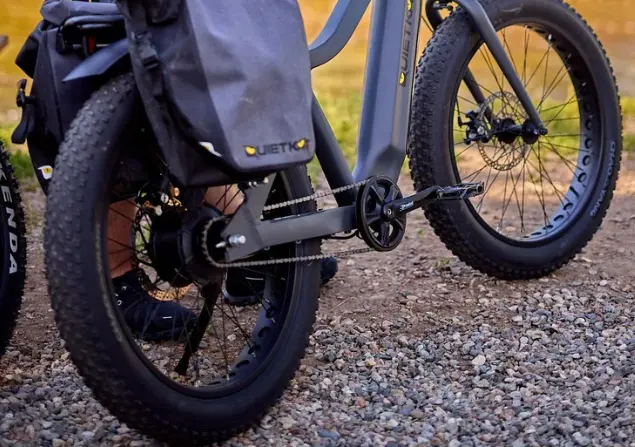
Why Big Tires Matter on an Electric Bike
Big tires change how an e-bike feels. A standard city e-bike may be efficient on smooth roads, but it can feel nervous on sand, gravel, snow, broken pavement, or wet paths. Big tires help spread the rider’s weight over a larger surface area, improving traction and stability.
This makes them useful for:
- Beach riding
- Snow and winter paths
- Gravel roads
- Forest trails
- Farm tracks
- Urban potholes
- Delivery routes
- Heavier riders
- Cargo carrying
- Recreational off-road riding
The tire itself acts like a form of suspension. When run at suitable pressure, a fat tire can absorb small bumps and reduce vibration before it reaches the frame and rider.
Best Overall Type: Fat Tire Utility E-Bike
For most buyers, the best choice is a fat tire utility e-bike with a strong frame, comfortable riding position, hydraulic disc brakes, front suspension, and a removable battery. This type of bike can handle daily commuting, weekend trails, light cargo, and mixed road conditions.
A good utility model should feel stable at low speed and controlled at higher assist levels. It should not be so heavy that the rider struggles to move it, lift it, or store it.
Look for:
- 4-inch wide tires
- 48V or 52V battery system
- Strong rear hub motor or mid-drive motor
- Hydraulic disc brakes
- Front suspension fork
- Comfortable saddle
- Rear rack compatibility
- Integrated lights
- Clear display
- Durable frame
This category is usually the safest recommendation for riders who want one bike for many situations.
Best for Commuting: Big Tire Urban E-Bike
A commuter-focused big tire e-bike should not feel like an oversized off-road machine. It should be stable, but still efficient enough for daily roads. For city riders, comfort and reliability matter more than extreme power.
The best commuter setup usually includes:
- Moderate tire width
- Upright riding position
- Good fenders
- Rear rack
- Bright lights
- Strong brakes
- Smooth pedal assist
- Removable battery
- Comfortable handlebar reach
For commuting, electric bikes big wheels are especially useful when the route includes rough pavement, tram tracks, road edges, gravel shortcuts, or wet conditions. The extra tire volume can make daily riding less tiring.
Best for Off-Road Riding: High-Torque Fat Tire E-Bike
For trails, hills, sand, mud, and forest roads, motor torque becomes more important than headline wattage. A high-watt motor may look impressive, but torque delivery determines how well the bike climbs and pulls through loose ground.
Off-road buyers should focus on:
- Strong torque output
- Durable frame
- Wide tires with aggressive tread
- Hydraulic brakes
- Larger brake rotors
- Front or full suspension
- High-capacity battery
- Strong rims and spokes
- Good ground clearance
A bike used off-road should also have a battery and controller designed for high current demand. Soft surfaces drain power quickly, so battery capacity matters.
Best for Long Range: Large Battery Big Tire E-Bike
Big tires create more rolling resistance than narrow tires. That means a big tire e-bike may use more energy, especially at higher speeds or on soft ground. If range matters, choose a battery based on watt-hours, not only amp-hours.
Watt-hours are calculated by multiplying voltage by amp-hours. For example, a 48V 20Ah battery stores about 960Wh of energy. A 52V 20Ah battery stores about 1,040Wh.
For long-distance riding, delivery work, or rural travel, a larger battery can make the difference between a useful bike and a stressful ride. A removable battery is also valuable because it makes charging easier.
Best for Heavy Riders or Cargo
Big tire e-bikes can be a good option for heavier riders or cargo use, but the frame and components must be rated properly. Do not judge by tire size alone.
Check:
- Maximum payload rating
- Frame strength
- Rack load capacity
- Wheel strength
- Spoke quality
- Brake size
- Motor torque
- Battery discharge rating
- Suspension limits
A bike carrying cargo or a heavier rider needs strong brakes and stable handling. A weak braking system can become a bigger problem than a weak motor.
Tire Size: How Big Is Big Enough?
Many big tire e-bikes use tires around 4 inches wide. Some use 3-inch tires, which are often called wide tires rather than true fat tires. Others use 4.5-inch or 5-inch tires for snow, sand, and soft terrain.
For most riders:
- 3-inch tires are good for city comfort and light gravel.
- 4-inch tires are the best all-around fat tire size.
- 4.5-inch to 5-inch tires are better for soft sand, snow, and rough off-road use.
Wider tires add grip and comfort, but they also add weight and rolling resistance.
Motor and Battery Matching
The best big tire electric bike should have a motor and battery that work well together. A powerful motor with a small battery may feel strong for a short time but lose range quickly. A large battery with a weak motor may offer range but struggle on hills.
For electric bikes big wheels, a balanced setup is usually better than an extreme spec. Buyers should look for smooth acceleration, dependable hill climbing, safe braking, and realistic range.
What to Avoid
Avoid buying only by appearance. Many big tire e-bikes look rugged, but the real quality is in the battery, controller, frame, brakes, wiring, tires, and after-sales support.
Be careful with:
- Unrealistic range claims
- Weak mechanical brakes on heavy bikes
- Unknown battery cells
- Poor waterproofing
- Low payload ratings
- Very heavy frames without enough motor power
- No replacement parts support
- No clear warranty
- Cheap suspension with poor control
A low purchase price can become expensive if the battery fails early or the bike cannot be repaired easily.
Conclusion
The best electric bikes with big tires are stable, comfortable, powerful enough for the terrain, and equipped with reliable brakes and a suitable battery. For most riders, a fat tire utility e-bike with 4-inch tires, hydraulic brakes, front suspension, and a removable battery offers the best balance of comfort, control, and everyday usefulness.
Big tires are especially valuable for riders who face rough roads, gravel, sand, snow, cargo loads, or long daily routes. By comparing motor torque, battery watt-hours, tire width, frame strength, and braking performance, buyers can choose a big tire e-bike that feels confident in real conditions.
For electric bike product information, visit Yonsland.
Post time: Aug-20-2026