

A purpose-built 5000W electric bike may be advertised with a top speed of roughly 45–55 mph (72–89 km/h) under favourable conditions. However, 5000W alone does not guarantee a specific speed. Actual performance depends on battery voltage, controller limits, motor design, wheel size, rider and cargo weight, terrain, tyre pressure, wind, battery charge level, and the vehicle’s programmed speed settings.
A 5000W model is a high-performance two-wheeler. In many regions, it may not be legally classified as a standard low-speed electric bicycle for public-road use. Always confirm local vehicle classification, registration, licensing, helmet, insurance, and road-access requirements before riding.
Quick answer: 5000W electric bike speed
| Operating condition | Possible result |
|---|---|
| Factory-limited road mode | Speed may be limited to comply with local rules |
| Flat road, fully charged battery, light rider | Higher top-speed potential |
| Hills, headwind, heavy cargo, or low battery | Lower top speed and reduced range |
| Higher-voltage performance system | Can support higher-speed potential when the full system is designed for it |
| Off-road or private-property mode | May allow higher performance, subject to local rules and safe operating conditions |
For most buyers, the manufacturer’s tested top-speed specification is more meaningful than motor wattage alone.
Why 5000W does not equal one fixed speed
Motor power describes how much electrical power the drive system can use. It does not tell the full story about speed.
A 5000W electric bike with a lower-voltage battery, conservative controller settings, large tyres, and heavy cargo may have very different performance from a lighter, higher-voltage model with a performance-oriented controller and aerodynamic riding position.
The complete drivetrain must be considered:
- Motor rated power and peak power
- Battery voltage
- Battery current capability
- Controller current limit
- Motor winding and wheel size
- Vehicle weight
- Rider weight
- Road gradient
- Wind resistance
- Tyre type and pressure
- State of battery charge
- Speed limiter settings
At higher speeds, air resistance increases significantly. This means a vehicle needs much more power to gain each additional increment of speed. As a result, real-world top speed may be lower than a claimed figure when riding uphill, against strong wind, with cargo, or on uneven roads.
Rated power versus peak power
When comparing electric racing bikes or high-performance electric bicycles, always check whether the advertised 5000W figure refers to rated power or peak power.
Rated power
Rated power is the motor output that the system is designed to sustain under specified operating conditions. It is usually the more useful figure for comparing continuous performance.
Peak power
Peak power is the higher output available for a short period, such as during acceleration or hill climbing. A product described as “5000W peak” may have a lower continuous power rating.
Buyers should ask for both figures. Comparing a 5000W rated system with a 5000W peak system can be misleading because their continuous performance, heat management, and acceleration capability may differ.
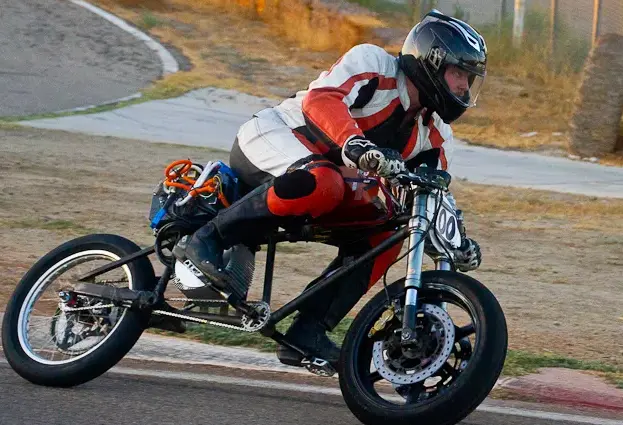
How battery voltage affects speed
Battery voltage is one of the major factors influencing the speed potential of a high-power electric two-wheeler.
In simple terms:
Power = voltage × current
A system using higher voltage can deliver power with lower current for the same wattage, provided that the battery, controller, motor, connectors, wiring, and protection systems are designed for that voltage.
However, higher voltage does not automatically make a vehicle safe, faster, or legal. Every component must be engineered as a matched system.
When evaluating a 5000W electric bike, review:
- Nominal battery voltage
- Fully charged battery voltage
- Battery capacity
- Battery-management-system rating
- Continuous discharge capability
- Controller current rating
- Motor temperature protection
- Charger compatibility
- Wiring and connector specification
Do not modify a battery, controller, or speed limiter unless the vehicle manufacturer and qualified professionals confirm that the complete system is designed for the change.
What affects real-world top speed?
Rider and cargo weight
More load requires more energy to accelerate and climb hills. A 5000W electric bike carrying a heavier rider, passenger, cargo, or accessories may reach a lower top speed than the manufacturer’s test result.
Terrain
Flat pavement generally provides the best top-speed conditions. Steep slopes, loose gravel, sand, mud, grass, and rough roads can reduce speed and increase battery consumption.
Wind resistance
At high speed, aerodynamic drag becomes a major factor. Riding into a headwind can noticeably reduce top speed and range, even when the motor is operating normally.
Battery charge and temperature
A fully charged battery may provide stronger performance than a partially discharged battery. Cold weather, excessive heat, battery age, and high continuous load can also affect available power.
Tyres and wheel size
Tyre diameter, tread pattern, tyre pressure, and rolling resistance can influence acceleration, stability, traction, and top speed. Tyres must be rated for the intended vehicle speed and load.
Is a 5000W electric bike legal on public roads?
Legal classification varies by country, state, province, city, and road type. A 5000W electric bike may be treated differently from a standard pedal-assist bicycle.
For example, the U.S. federal consumer-product definition for a low-speed electric bicycle applies to vehicles with operable pedals, a motor below 750W, and a motor-only speed below 20 mph on level ground. A 5000W vehicle will generally fall outside that low-speed definition and may be regulated locally as a moped, motor-driven cycle, motorcycle, off-road vehicle, or another category.
Before buying or operating a 5000W electric bike, check:
- Local motor-power limits
- Maximum permitted assisted speed
- Vehicle registration requirements
- Driver licence requirements
- Helmet rules
- Insurance requirements
- Age restrictions
- Road, bike-lane, and trail access rules
- Lighting, mirrors, horn, and brake requirements
A high-performance vehicle should only be operated where it is permitted and where its speed, braking system, tyres, suspension, and rider protective equipment are appropriate.
5000W electric bike versus standard e-bike
| Feature | Standard low-power e-bike | 5000W electric bike |
|---|---|---|
| Typical use | Commuting, leisure riding, short urban trips | High-performance riding, demanding terrain, specialized use |
| Motor output | Lower power | Much higher power potential |
| Typical speed | Often limited by local e-bike regulations | May reach motorcycle-like speeds |
| Braking needs | Bicycle-oriented system | High-performance hydraulic braking system is important |
| Legal status | Often defined as an e-bike when compliant | May require a different legal classification |
| Rider skill requirement | General cycling skills | High-speed handling and responsible operation are essential |
The higher power of a 5000W model can provide stronger acceleration and improved hill-climbing ability, but it also increases the importance of vehicle design, maintenance, rider training, and legal compliance.
Safety considerations for electric racing bikes
High-performance electric racing bikes should be treated as serious powered vehicles, not as ordinary bicycles with a larger battery.
Before riding, inspect:
- Brake pads, discs, and hydraulic system
- Tyre condition, pressure, and speed rating
- Wheel spokes, rims, and axle hardware
- Suspension components
- Battery enclosure and mounting
- Cables, connectors, and charging port
- Headlight, tail light, brake light, and turn signals where required
- Frame condition and fasteners
- Throttle response and motor cut-off function
Riders should use a properly fitted helmet and protective equipment appropriate for the operating speed and local law. Avoid carrying passengers unless the vehicle is specifically designed, rated, and legally approved for passenger use.
How to choose a 5000W electric bike
A good purchase decision should focus on the entire vehicle rather than the motor label alone.
Ask the supplier for:
- Rated motor power and peak motor power
- Tested top speed under stated conditions
- Battery voltage and capacity
- Battery cell type and battery-management-system specification
- Controller rating and thermal protection
- Brake type and rotor size
- Tyre size, load rating, and speed suitability
- Frame material and maximum load rating
- Suspension specification
- Charger specification and charging time
- Vehicle certification or market-compliance documents
- Warranty, spare-parts availability, and service support
A reliable high-power electric bike requires a balanced motor, battery, controller, braking, tyre, suspension, and frame system.
Conclusion
A 5000W electric bike can potentially reach around 45–55 mph under favourable conditions, but actual speed depends on the complete vehicle system and the riding environment. Motor wattage alone cannot predict top speed.
When evaluating electric racing bikes, compare rated power, peak power, battery voltage, controller limits, braking system, tyres, load capacity, and legal classification. A high-performance electric two-wheeler should be selected for safe, permitted use—not only for the highest claimed speed.
For 5000W electric bike information, product specifications, or purchasing enquiries, contact Yonsland PH.
FAQ
How fast can a 5000W electric bike go in km/h?
A purpose-built 5000W electric bike may be advertised around 72–89 km/h under favourable conditions. Actual speed can be lower or higher depending on the vehicle design, controller settings, battery voltage, rider weight, and road conditions.
Is a 5000W electric bike considered an e-bike?
It depends on local law. In many markets, a 5000W two-wheeler exceeds the power limits used for standard e-bike classifications and may be regulated as a moped, motorcycle, or off-road vehicle.
Does a 5000W motor always make an electric bike faster?
No. Top speed depends on voltage, controller limits, motor design, wheel size, load, terrain, wind, battery condition, and speed settings. A 5000W label alone does not guarantee a specific speed.
Can electric racing bikes be ridden on public roads?
Only where local law permits them. Riders should verify registration, licensing, helmet, insurance, equipment, and road-access rules before using a high-performance electric bike on public roads.
Post time: Sep-30-2026