

If you’re buying e-bikes for a fleet or rental program, the sticker price rarely tells you what you’ll actually pay. A quote can look cheap and still cost more over a year once batteries, service, downtime, and compliance enter the picture. The short answer: e-bike prices bundle hardware, certification, distribution, and risk-transfer costs, so the fair comparison is cost per bike per year, not the price on the quote. This guide walks through what drives those costs, how the $800 to $6,000+ price tiers differ, why e-bikes can cost more than mopeds, and how to run your own quote audit before you commit.
What Makes Up an E-Bike Price, Explained Simply
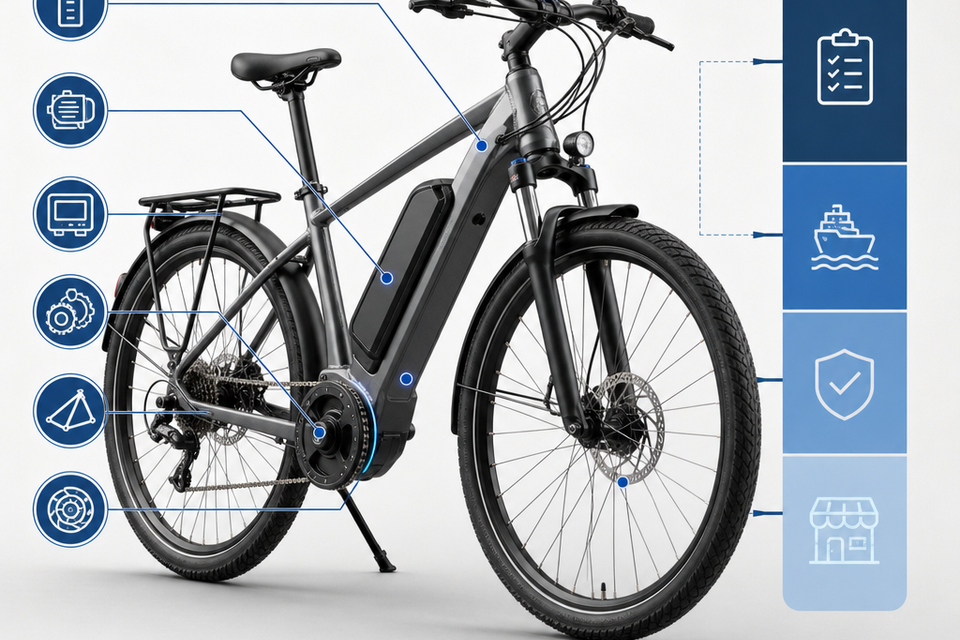
The battery and motor account for much of the hardware cost, but certification, import logistics, and retail margin add layers that many buyers never see. Understanding these components helps explain why two bikes that look similar can differ significantly in price.
A fleet e-bike price bundles hardware, compliance, distribution, and risk-transfer costs. Judge any quote by cost per operating hour, not cost per unit.
Think of an e-bike as a small battery-powered appliance on a bicycle frame. It carries electrical and transport-safety cost layers that a plain bicycle never faces. Certifications such as UL 2849 require testing and documentation, and sellers build that cost into the price.
The battery is the largest visible layer. One community estimate puts it at about a third of the price, though the split varies by model. The costs that hide in a cheap quote show up later:
- Battery cells: Lower-grade cells often lose capacity sooner, so you buy replacement packs earlier.
- Service coverage: Thin coverage turns one fault into days of idle bikes.
- Warranty terms: Narrow warranties push replacement and labor costs back onto your operation.
Some buyers argue a cheaper bike is fine if it only needs to last a season. However, a low sticker price often moves these costs into your daily operations.
The rule: Pay more up front when the premium, spread across expected operating hours, costs less than what you save per hour on battery swaps, repairs, and idle time. A pricier bike that runs longer between battery swaps and repairs wins on cost per hour.
Before comparing quotes, get written answers on warranty length, battery terms, and service response times. Our team can help you build a cost-per-hour comparison for your fleet.
How the Core Components Drive Cost
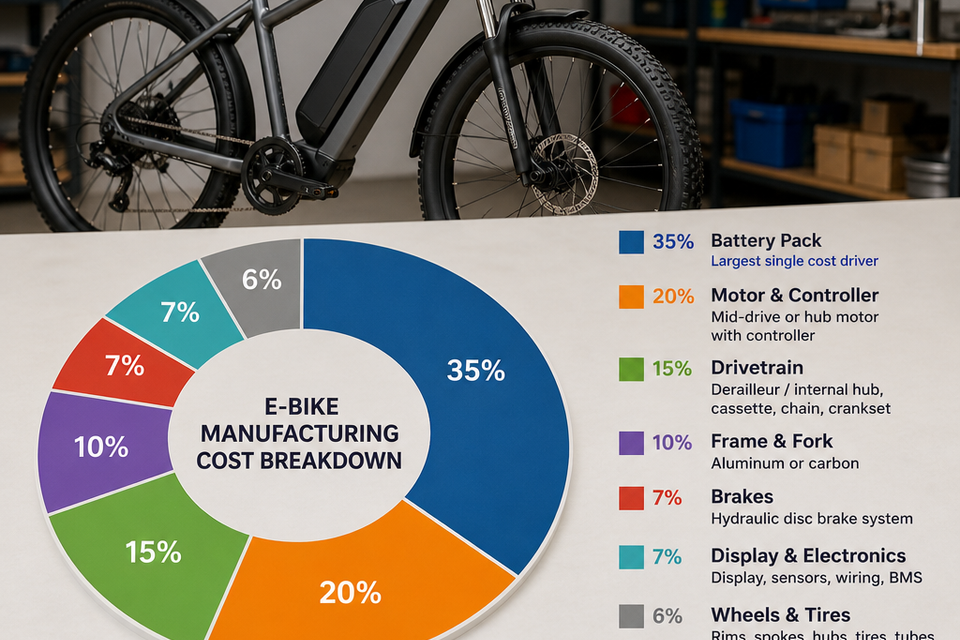
The battery pack and motor account for the largest share of an e-bike’s component cost, which is why capacity, motor rating, and brand-name cells explain most of the price gap between entry-level and premium models. Shares are indicative and vary by build quality and sourcing volume.
Cheaper electric bikes usually carry the same parts as expensive ones. The gap sits in how each part is built, rated, and tested. A budget battery, motor, and frame can look identical on a spec sheet while lasting far less under daily fleet use.
Battery: cell grade, capacity, and pack management
Think of cells like tires. Two sets can share the same size and still wear at very different rates. Higher-grade cells keep more capacity after hundreds of charge cycles, and cheap cells lose range faster.
Capacity (Wh) adds cost because it adds cells. The battery management system (BMS) matters just as much. It balances cells, cuts power at unsafe temperatures, and protects against overcharge. A basic BMS costs less and does less.
Motor and controller: torque curve and duty cycle
A motor’s torque curve shows how much pull it delivers at each speed. Budget motors often hit a strong peak at low speed, then fade on hills or with a loaded cargo box.
Duty cycle describes how long a motor can run under load before it overheats. A motor rated for short bursts costs less than one built for continuous climbing with a 150 kg load. For fleets, duty cycle usually matters more than peak power.
Brakes, frame, drivetrain, display, and software
Brakes are a safety cost you can test. Rotor size, hydraulic versus mechanical actuation, and pad material all affect stopping power under heavy loads.
Frame testing is the cost buyers overlook most. Better manufacturers test frames for fatigue at rated load. Cheaper frames may pass the same static test but fail sooner in stop-start rental use.
Drivetrain, display, and software tend to differ less in price than in durability and update support. Ask who fixes firmware and how long spare parts stay in stock.
Common misconception: “Same specs, same bike”
Some buyers argue that matching specs mean matching quality. However, spec sheets list capacity and rated power. They rarely list cell grade, BMS features, or duty-cycle testing.
How to audit a quote
- Request itemized quotes from at least three manufacturers at similar price points.
- Record each line for battery, motor, drivetrain, display, brakes, frame testing, and certification.
- Ask which cells, BMS, and motor duty rating each supplier uses.
- Check certification scope. Look for EN 15194 for EU-market e-bikes and UL 2849 for North American electrical systems. Confirm whether certification is included or billed separately.
- Confirm whether the quote covers shipping-safety testing such as UN 38.3 for lithium batteries.
This audit shows where quotes differ. I haven’t set cost shares here. The audit in Section 3 will show how much of each price goes to each component. If a supplier won’t itemize, send your spec list through our electric bikes contact page.
Price Tier Breakdown: What Changes Between $800 and $6,000+
A $800 bike and a $6,000 bike differ in three places: the battery and components, the certification paperwork, and the service behind the bike. For fleet buyers, the sticker price alone doesn’t show which tier gives the lowest cost per bike per year.
What the data can and can’t show yet
We have not yet collected audited cost shares by bucket. A fair breakdown needs itemized quotes from several manufacturers at each price point, coded to battery, motor, drivetrain, display, frame, brakes, certification, and channel. Until that data exists, treat the “battery is about a third” figure from a Stack Exchange thread as a community estimate, not a measured split.
What changes at each tier
- $800: Check whether the quote includes certification documentation, a named service network, and warranty terms. Budget quotes often leave one or more of these out.
- $3,000: Expect the paperwork, a longer warranty, and dealer service to be itemized.
- $6,000+: The gain is component grade and integration: cell quality, motor torque tuning, brake and frame testing, and software that works with the display.
The 3-10x gap comes mostly from these specification differences. Riders can usually spot the trade-offs, but few can size the gap. Itemized lines make that sizing possible.
Guidance rule: If a quote’s battery or certification lines are missing or unlabeled, request the itemization before you compare totals.
Illustrative scenario (hypothetical operator, 20 bikes)
Option A is a $1,500 bike. Option B is a $3,000 bike with a longer warranty and dealer service. Every input below is an assumption. Replace it with your quotes.
- Horizon: 4 years, straight-line
- Resale: A $300, B $900
- Battery: A $400 every 2 years, B $450 every 3 years
- Service: A 2 visits/year at $80, B 2 visits/year at $40
- Downtime: A 6 days/year, B 2 days/year, at $25 lost margin per day
- Insurance: $120/year for both
| Cost item (per bike, per year) | A ($1,500) | B ($3,000) |
|---|---|---|
| Depreciation net of resale | $300 | $525 |
| Battery | $200 | $150 |
| Service | $160 | $80 |
| Downtime | $150 | $50 |
| Insurance | $120 | $120 |
| Total | $930 | $925 |
Across 20 bikes, that’s $18,600 versus $18,500 per year. Downtime is the swing factor. If Option A loses 10 days instead of 6, its cost rises to $1,030 per bike.
Build your own template
Use four columns: Input, Option A, Option B, and Notes. Enter one row per assumption above. Then calculate:
Annual cost = (Price − Resale) ÷ Years + Battery price ÷ Battery interval + (Visits x Visit cost) + (Downtime days x Daily margin) + Insurance
If you want help comparing real quotes for electric bikes, contact our team with itemized pricing.
Why E-Bikes Cost More Than Mopeds and Motorbikes
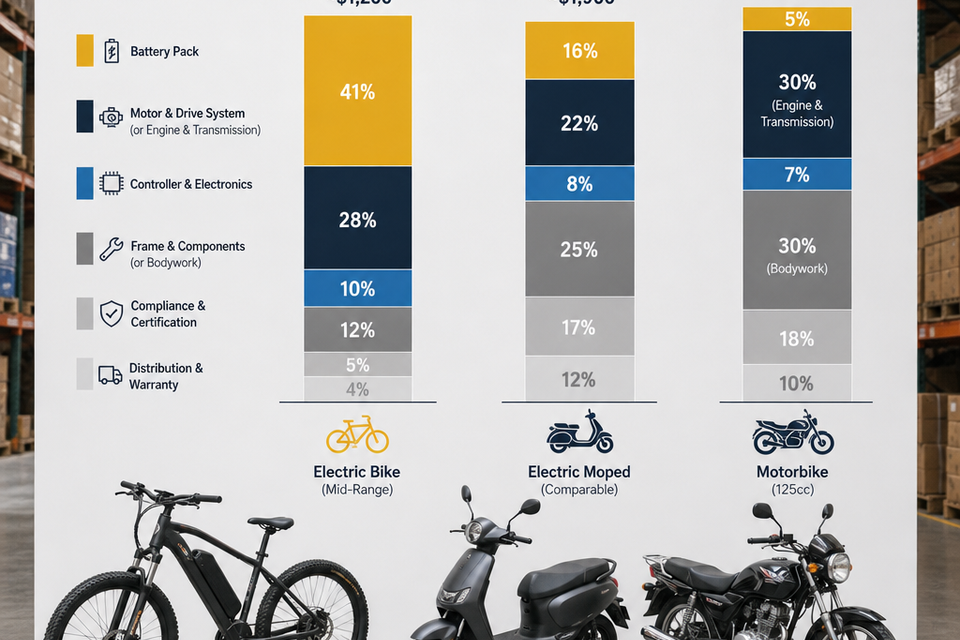
The battery and drive system account for the largest share of an e-bike’s cost, a gap that moped and motorbike buyers rarely face at the same price point. Readers should come away understanding which components drive the price difference, so they can judge whether the premium reflects value or markup.
E-bikes cost more than mopeds because four cost drivers stack up. “Economy of scale” alone hides what you actually pay for.
The four drivers
- Production volume. Mopeds and motorcycles run long, stable platforms, and suppliers have spread their tooling costs over years. Many e-bike brands produce smaller batches across many frame sizes and variants, so each unit carries more setup cost.
- Homologation. Motorized two-wheelers often need type approval and registration. Most e-bikes fall under pedelec rules, which move compliance cost into bicycle-side testing and documentation.
- Battery sizing. A moped’s energy system is built for its vehicle class. An e-bike battery must be compact, light, and fit a frame, which raises cost per kWh.
- Warranty reserve. Fleet and rental buyers expect multi-year battery and component coverage. The manufacturer prices that reserve into every unit.
Reframe the question: what does each tier buy for my trips?
Use a cost-per-trip model before you compare quotes:
Cost per trip = (purchase price − resale value + maintenance + battery replacement reserve) ÷ total trips over ownership
Example: a $3,000 bike that runs 6,000 trips before retirement costs $0.50 per trip before maintenance and resale. Run the same math on a cheaper bike that needs a battery at half the life, and the gap can reverse.
Spec-to-price checklist
- Battery cells and warranty: Ask the cell brand and whether warranty is pro-rated by years or cycles.
- Motor type: Confirm the motor’s placement and whether service parts sell separately.
- Controller and display: Proprietary systems lock repairs to one supplier.
- Parts availability: Ask for lead times on batteries and controllers.
- Service support: Confirm who repairs the bike and how fast.
Decision path
- Pay more when the bike runs daily, downtime costs more than the premium, and the warranty covers cells and controller in writing.
- Skip the premium when trip counts are low, the bike rides short routes, and the extra spec sits in parts you will never replace.
For a line-by-line quote review against your trip count, contact our team.
Certification and Compliance as a Real Cost Line
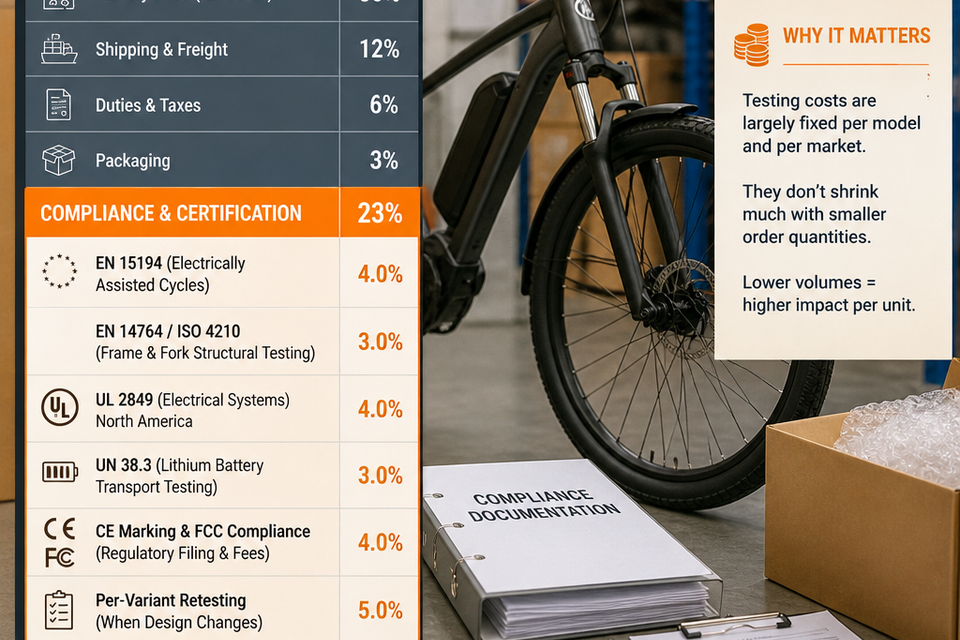
Certification costs are mostly fixed per model and per market, so they weigh more heavily on low-volume orders. Budget for them as a line item, not an afterthought, especially when planning MOQs or launching in multiple regions.
Certification is a real cost when it pays for testing, documentation, factory audits, or retesting. It is marketing when a logo appears with no test report behind it. Ask for the evidence before you compare quotes.
What each standard costs you
- UL 2849 covers the e-bike’s electrical system. The cost driver is lab testing of the motor, controller, wiring, and display as a system.
- UL 2271 covers batteries for light electric vehicles. The cost driver is cell and pack testing.
- EN 15194 is the EU standard for pedal-assist (EPAC) bikes, usually assessed through a notified body. The cost driver is third-party assessment and documentation.
- TÜV is independent testing with its own certification marks. The cost driver is the test program and certificate.
- CE is a declaration of conformity under applicable EU directives. The cost driver is the technical file the manufacturer keeps.
- UN 38.3 is transport testing for lithium cells and packs. The cost driver is the testing required before shipping.
How the cost scales
Test fees and documentation are mostly fixed per model. Imagine two models with the same test bill. One sells 100 units and the other sells 5,000. The certification cost per bike differs by 50 times. Swapping a battery cell or controller often triggers retesting, and that cost shows up in the next quote.
Next steps
- Pull the current fee schedules from UL, TÜV, and the relevant notified body.
- Ask the manufacturer for test reports and certificate numbers. Check the numbers against the issuing body’s database.
- Compare quotes on a cost-per-trip basis: (purchase price + retesting share + battery replacement + parts + service) ÷ expected trips.
A higher price is justified when the quote includes verifiable certificates, a battery warranty you can claim against, and parts you can source locally. It is not justified when the premium only buys a logo. For a tailored quote review, contact our team.
Distribution Channels: Direct, Online with Shipping, and Dealer-Supported
The cheapest sticker price doesn’t always mean the lowest cost to run. Direct and online channels cut the dealer margin, but the work that margin pays for still has to happen somewhere. For fleet and rental buyers, that work often costs more than the savings.
Compare the channels on the same cost list:
- Assembly: Dealers assemble in-store. Online buyers assemble at home, and mistakes show up later.
- Pre-delivery inspection: Dealers check brakes, torque, and wheel alignment before handover. Online buyers either skip this step or pay a shop to do it.
- Shipping and crating: Online bikes arrive boxed. You carry the damage risk and the claim process.
- Service, returns, and warranty: Dealers handle claims locally. Direct sellers route claims by mail or remote diagnosis.
Where the savings reappear: Direct sellers drop the dealer margin, but self-assembly errors, transit damage, and remote warranty claims add days out of service. For a rental operator, a bike that sits for two weeks can cost more than the margin you saved.
Use cost per operating hour to compare:
- Add the purchase price, setup cost, and expected service cost.
- Divide by the hours you expect the bike to run over its life.
- Add the revenue lost for each day it sits waiting for parts or a technician.
A cheaper bike with slow repairs can cost more per hour than a dealer-supported bike.
Decision path:
- Pay more for a dealer-supported bike if downtime costs you revenue, you lack in-house technicians, or you run daily cargo or rental routes.
- Choose direct or online if you buy a few bikes, can assemble and inspect them, and can wait for remote warranty support.
For a tailored quote review based on your route, fleet size, and downtime tolerance, contact our team.
Fleet Scenario: 20 Bikes at $1,500 Versus $3,000
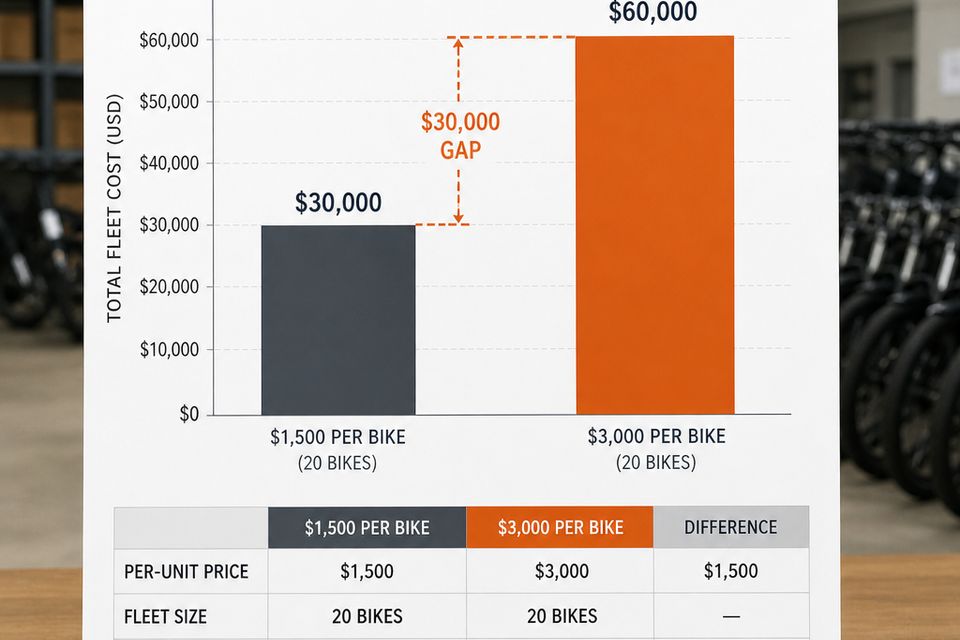
At 20 units, a $1,500 difference per bike becomes a $30,000 difference in fleet spend. When evaluating quotes, multiply the per-unit price difference by fleet size to see the true budget impact, then check whether the higher price reflects features, warranty, or service terms your fleet actually needs.
The $1,500 bike is cheaper only if it stays on the road. Compare annual cost per bike, not sticker price. This scenario is hypothetical. Every input is an assumption, so replace each one with quoted figures before you decide.
Assumptions to replace
- Purchase price per bike
- Battery replacement cost and interval, per model
- Service visits per year and cost per visit
- Downtime days per failure and daily revenue lost
- Insurance per bike per year
- Resale value at year 3
Formula
Annual cost per bike = (purchase − resale) ÷ years + (battery cost ÷ battery life in years) + (service visits x visit cost) + (downtime days x daily revenue lost) + insurance
Illustrative run (hypothetical inputs)
- Bike A ($1,500, $200 resale): $433 depreciation + $200 battery + $180 service + $100 downtime + $80 insurance = $993/year
- Bike B ($3,000, $900 resale): $700 depreciation + $150 battery + $120 service + $50 downtime + $120 insurance = $1,140/year
Divide by annual trips or operating hours for cost per trip. At 1,000 trips per year, Bike A costs about $0.99 per trip and Bike B about $1.14.
Build the spreadsheet in three tabs
- Inputs: every assumption, with the quote source noted beside it.
- Calculation: the formula, run for each model.
- Sensitivity: change one input at a time to find the flip point.
In this example, Bike A loses its lead at about 10 downtime days per year. That flip point matters more than the purchase price.
Spec checks that move the numbers
- Battery cell brand and warranty terms
- Motor type and its service history
- Controller and display ecosystem
- Local parts availability
- Service support response time
Decision path
- Pay more when downtime costs exceed the annual price gap, or when the cheaper model lacks local parts.
- Buy cheaper when routes are short, daily revenue loss is low, and parts are stocked nearby.
Request a tailored quote review to run these numbers with your actual quotes.
Counter-Arguments and Limitations of the Cheap-Quote Logic
A lower quote wins only when its cheaper parts don’t add enough downtime and replacement cost to erase the savings. For low-use rentals, that often holds. For daily fleet, shop, and cargo work, the cheapest bike can cost the most per trip.
Where cheap wins. A seasonal tourist fleet with low annual hours may never reach the battery cycle count where a premium pack pays back. One Stack Exchange answer puts the battery at about a third of an e-bike’s price. Treat that as a rough community figure, not a benchmark, but it shows why battery quality deserves a line-item check.
Limits of the analysis.
- Resale is thin and volatile. Don’t count resale value you can’t verify.
- Warranties define failure differently. Some cover cells only. Others cover capacity loss past a set threshold. Read the definition, not the headline.
- Battery life depends on use. Charging habits and climate shift pack life, so ask for service-interval data, not just a warranty length.
A higher price doesn’t guarantee lower cost. Verify the warranty document and service data before you accept a premium quote.
Cost per operating hour
Cost per hour = (purchase price + battery replacements + repairs + downtime cost) ÷ operating hours over service life.
Run the same formula on each quote, using your own hour and downtime estimates.
Spec-to-price checklist. Ask every seller:
- Which battery cell brand, and what do the written warranty terms say?
- Which motor type, and what is its rated torque?
- Which controller and display system, and can you buy spares for it?
- Where are parts stocked, and how fast can you get them?
- What is the service response time, and who performs repairs?
Decision rule. Pay more up front when expected downtime and battery-replacement savings over service life exceed the price difference, adjusted for utilization. Low annual hours favor the cheaper quote. High-hour fleets often favor the premium quote, but only if the warranty and service terms hold up.
Want a second opinion on your numbers? Request a tailored quote review.
Common Buyer Mistakes When Comparing E-Bike Quotes
The most common mistake is comparing total prices. A quote that looks cheaper often omits a battery line, a certification report, or assembly. Itemize every quote before you compare.
Watch for these four errors:
- Treating “free shipping” or “buy direct” as a discount. Add assembly, pre-delivery inspection, and service visits. Those costs show up later on your fleet budget.
- Accepting a certification logo. Ask for the test report and certificate number. A logo alone gives you nothing to verify.
- Skipping warranty exclusions. Check whether the warranty covers battery capacity loss, cycle count limits, and charger damage. These are often carved out.
- Comparing e-bikes to mopeds on sticker price. Homologation, battery sizing, and warranty terms explain much of the gap.
For fleet, shop, and cargo buyers, compare cost per trip:
(Purchase price + battery replacement reserve + service + downtime) ÷ expected trips over the bike’s life
A cheaper bike with a short battery warranty can cost more per trip than a higher-priced bike with a named cell brand and local parts.
Check each quote against this list:
- Battery cell brand and warranty terms
- Motor type and rated output
- Controller and display compatibility
- Parts availability in your region
- Service response time
Pay more when the quote includes test reports, a written battery warranty, and local parts. Do not pay more for a premium badge on identical specs. Request a tailored quote review to compare your shortlist line by line.
Getting Started: Running Your Own Quote Audit
Run your own quote audit by collecting matching, itemized quotes from at least five manufacturers and comparing them line by line. Purchase price alone hides most of the cost, so the audit shows what each price tier actually buys for your routes and duty cycle.
1. Request matching quotes. Ask five suppliers at comparable price points for the same line structure: battery, motor, drivetrain, display, certification, shipping, and warranty. Reject bundled totals.
2. Get documents in writing. Request test reports, certificate numbers, battery warranty text, and service-interval documentation. A verbal promise won’t help when a battery fails in month eight.
3. Record and flag gaps. Log each quote in one template and flag every missing line. A quote that omits certification or shipping looks cheaper only because it leaves costs out.
4. Compare cost per bike per year. Use the Section 7 formula, which divides total cost (purchase, shipping, expected battery replacement, service) across the years you run the bike.
Community threads often say the battery is about a third of a bike’s cost. Treat that as a rough check, not a benchmark. If a battery line looks far off from the rest of the quote, ask why.
What to check on each spec:
- Battery cells: brand, cell grade, and warranty length
- Motor type: hub or mid-drive, and rated torque
- Controller and display: whether parts and software are proprietary
- Parts availability: who stocks spares and how fast they ship
- Service support: response times and who performs repairs
When a higher price is justified: the premium buys documented battery warranty, certified test reports, and local spares that cut downtime.
When it isn’t: the premium pays for brand image or features your routes never use.
For fleet or dealer-supported quotes, send your template to our team at https://www.yonslandph.com/contact-us/ for an itemized review.
Frequently Asked Questions
Short answer: Compare cost per operating hour, not sticker price. Each price tier buys a different number of hours before downtime, and that gap drives your real cost.
Why are e-bikes more expensive than mopeds if both are electric? Mopeds ride on a vehicle approval process built for volume. E-bikes use bicycle-grade frames and brakes, and their batteries must handle daily fleet use. Buyers also expect longer warranties, and those costs reach the price.
Does a UL or TÜV badge change the price? Yes, mostly through fixed testing costs per model. Small batches absorb more cost per unit. Ask for the test report and confirm the model number matches your quote.
Is buying direct always cheaper for a rental fleet? No. Direct buying lowers the unit price, but you take on warranty claims, parts sourcing, and repairs. Count those costs before you sign.
Which single number should I compare? Use cost per operating hour:
(Purchase price + battery replacements + parts + repair labor + downtime cost) ÷ rentable hours over the bike’s life
Illustrative inputs only: Bike A costs $1,500 and needs $700 in batteries and parts over 2,000 rental hours. That works out to $1.10 per hour. Bike B costs $3,000 and needs $900 over 4,000 hours, or $0.98 per hour. The pricier bike wins because it runs longer.
Check these specs before you compare prices:
- Battery: cell brand, cycle rating, and what the warranty covers
- Motor: type, and whether you can replace it without rewiring
- Controller and display: one ecosystem across the fleet, so one diagnostic setup works
- Parts: how many days to get a spare motor or battery
- Service: who makes repairs, and the response time in writing
Decision path:
- A higher price is justified when bikes run many hours a day, downtime costs revenue, and the supplier stocks parts.
- A higher price is not justified when use is seasonal, hours are low, or the bike is cheap to replace.
- If a supplier cannot answer the warranty or parts questions in writing, walk away regardless of price.
Request a tailored quote review to run this model on your actual quotes.
Conclusion
The main takeaway is that a lower quote only wins if its battery, service, warranty, and certification terms hold up over the bikes’ working life. Compare itemized quotes using the same line structure, ask for test reports and warranty text in writing, and calculate cost per bike per year using your own utilization, downtime, and resale assumptions. If you want help reviewing a quote or building a fleet comparison around your real numbers, contact our team at https://www.yonslandph.com/contact-us/ to get an itemized review.
Post time: Nov-25-2026