

One of the most common questions riders type before a weekend outing is simple: "What ebikes are allowed on trails?" The honest answer is that there is no single nationwide yes or no. Trail access for electric bikes depends on the e-bike's class, which agency manages the land, and whether the route is singletrack, a paved multi-use path, a park road, or a private riding area. This guide breaks down the three legal classes of electric bikes, where each one is generally accepted, and how to verify the specific trail before you turn the battery on.
First: What Counts as an Electric Bike?
In the United States, the common federal and state definition covers a two- or three-wheeled bicycle with fully operable pedals and an electric motor of no more than 750 watts. Electric bikes that exceed the motor limit, remove the pedals, or operate without assistance support are treated as mopeds, motorcycles or low-speed vehicles, and trail rules for those are entirely different — usually much stricter.
Riders also encounter the abbreviation "eMTB," which simply means an electric mountain bike: an off-road style electric bike built for dirt rather than pavement. Whether an eMTB belongs on a given trail comes down to its class and the land manager's sign at the trailhead.
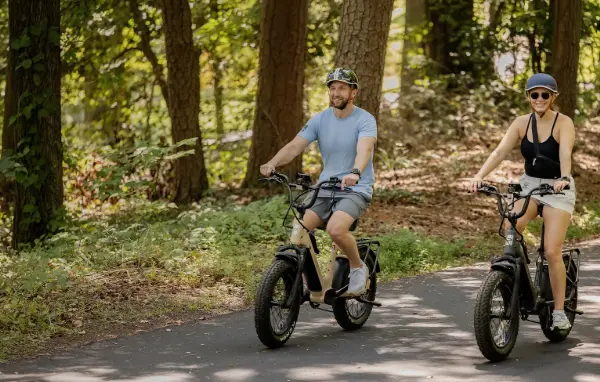
The Three E-Bike Classes Used on Trails
|
Class
|
How the motor works
|
Assisted speed cap
|
Typical trail treatment
|
|
Class 1
|
Pedal-assist only: motor helps only while you pedal; no throttle
|
Cuts out at 20 mph
|
Most widely accepted on mountain bike singletrack
|
|
Class 2
|
Throttle-assist: motor can propel the bike without pedaling
|
Cuts out at 20 mph
|
Allowed on many roads and paved paths; often banned on non-motorized singletrack
|
|
Class 3
|
Pedal-assist only, higher assist
|
Cuts out at 28 mph
|
Usually restricted to roads and bike lanes; rarely allowed on dirt trails
|
Class 1 electric bikes are the easiest fit on trails because they behave like a conventional bicycle with added help on climbs. Class 2 bikes with a throttle attract the most restrictions, since management groups them closer to motorized recreation. Class 3 bikes move faster under power and are commonly limited to roadway use; many states also set helmet and minimum-age requirements for Class 3 riders.
Federal Public Lands: The Default Rule, With Local Exceptions
On federal land managed by the U.S. Forest Service and the Bureau of Land Management, the standing policy treats electric bikes the same as traditional bicycles: allowed where bicycles are allowed, and prohibited where bicycles are prohibited. That general rule, however, does not grant blanket access to every single trail.
Many non-motorized, narrow mountain bike trails on federal land stay closed to throttle-equipped Class 2 bikes and to faster Class 3 bikes, even when Class 1 pedal-assist bikes are permitted. Individual ranger districts may open selected trail networks to Class 1 electric bikes while keeping other routes off-limits, and these decisions are revised over time. National Park Service units set their own access rules, which vary from one park to another: some permit only Class 1 bikes on carriage roads and paved routes, while others allow all three classes on motor roads but restrict trails.
State Parks, County Trails and Local Recreation Areas
State park systems, county open-space districts and land trusts write their own rules, and they do not align perfectly with each other. In some state parks, Class 1 pedal-assist electric bikes are accepted on every bike-designated trail, including singletrack; Class 2 and Class 3 bikes may then be restricted to park roads. In other parks, all electric bikes are kept off dirt trails regardless of class.
Paved rail-trails, greenways and canal paths are generally the most welcoming environment: Class 1 and Class 2 electric bikes are often allowed, while Class 3 bikes may be excluded for speed. Private bike parks, rental operations and trail associations set their own access policies independently, so a public-land assumption can mislead you there.
Where Electric Bikes Are Usually Banned
Even when electric bikes are broadly accepted, the following settings commonly close to them:
- Primitive or wilderness areas, where motorized assistance of any kind is excluded by designation.
- Narrow non-motorized singletrack managed as hiking-only or equestrian-only.
- Class 3 routes on nearly all dirt trails, because the higher assisted speed conflicts with trailwidth and user density.
- Throttle-only or unclassed motorized two-wheelers, which fall outside bicycle rules entirely.
- Locally protected natural areas, reserves and wildlife habitat zones, which may ban all e-bikes by signage.
Checklist Before You Ride
- Identify your class. Check the bike's specification for pedal-assist vs. throttle, the assisted speed cutoff, and the motor wattage (750 W limit for bicycle treatment).
- Read the trailhead sign first. Signs are the controlling authority; agencies update allowed classes on specific routes.
- Check the managing agency's website or app for the exact trail: Forest Service district, BLM field office, NPS park, state park, county open space, or private association.
- Match the route type. Expect easier access on paved multi-use paths and bike roads; expect tighter limits on singletrack.
- Obey local equipment rules such as helmets, age minimums, and a visible class label where required.
- Ride trail etiquette: yield to hikers and horses, keep speed low in crowded sections, announce yourself on blind corners, and never leave designated tread.
FAQ: Ebikes on Trails
Are Class 1 electric bikes allowed on mountain bike trails?
Class 1 pedal-assist bikes are the class most commonly permitted on singletrack, but the specific trail's managing agency decides; signs and official maps override general assumptions.
Why are Class 2 throttle bikes often banned on dirt?
Throttle propulsion moves the bike under power without pedaling, which agencies associate more closely with motorized recreation on narrow non-motorized trails.
Can I ride a Class 3 e-bike on trails?
Class 3 electric bikes (pedal-assist to 28 mph) are usually limited to roads and designated bike lanes and are rarely allowed on dirt trails.
Do national parks allow e-bikes?
Access varies park by park. Some allow Class 1 on paved routes or carriage roads, others allow all classes only on motor roads; check each park's compendium or trail map.
What should I do if the sign does not mention e-bikes?
Treat silence conservatively: contact the managing agency before riding, and do not assume silence means permission.
Conclusion
Electric bikes continue to gain trail access, but the rules are written per class, per agency and per trail. Class 1 pedal-assist bikes offer the broadest compatibility; Class 2 throttle bikes face the most singletrack restrictions; Class 3 bikes mostly belong on roads. Before every ride, confirm the class on your spec sheet, read the trailhead signage, and check the agency map for that specific route.
If you are looking for a trail-ready electric bike matched to the riding rules above, the Yonsland team can help you choose the right class and setup for local trails — Contact Us here.
Post time: Oct-22-2026